Roof Repairs
Leak and tile repairs from Glenbrook to Mount Victoria, where moss on shaded pitches and frost-damaged pointing cause most failures.
Learn more →A stain on the ceiling after three days of fog, or ridge pointing that has gone to powder after one too many frosts. We look at it, tell you what is actually wrong, and put the price in writing.
The settlements here run in a line along a single sandstone ridge, with the Great Western Highway and the railway threaded between them and Blue Mountains National Park dropping away into gorges on both sides. Glenbrook sits at about 163 metres. Blackheath, seventy-odd kilometres west, sits at about 1,065 metres. That difference in altitude is the most useful thing anyone can tell you about a roof in this area.
At Glenbrook and Blaxland the enemies are ultraviolet, summer heat and leaf litter. At Katoomba, Blackheath and Mount Victoria the enemies are water that never quite dries, frost on most winter mornings, and two or three settled snowfalls a year. The same concrete tile roof fails in a different way at each end of the line, and the right repair is different too.
Call (02) 4703 5000 and we will come and look at it. The inspection and the written quote cost you nothing.
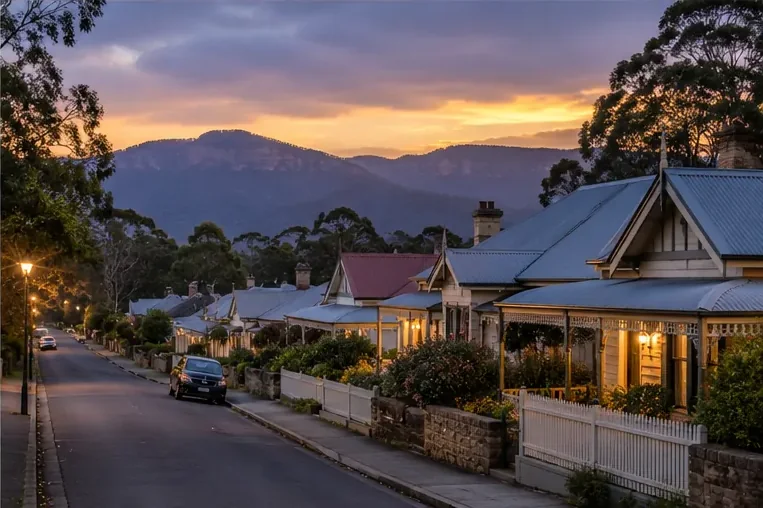
Roughly 70% of the Blue Mountains local government area sits inside Blue Mountains National Park, and the NSW Rural Fire Service describes the district as one of the most bush fire prone in the state. The bush fire prone land map is prepared by council and certified by the RFS Commissioner — the current version was certified in 2025 — and your Section 10.7 planning certificate will tell you how your own block is mapped.
For roofing that is not an upsell, it is just part of the job. Where a Bushfire Attack Level applies under AS 3959, the detail work matters: a fully sarked roof, a sealed roof-to-wall junction, non-combustible ember guards at openings and penetrations, metal gutters and a roofline that does not hold leaf litter. Worth knowing that an ember guard and a leaf guard are not the same product — plenty of gutter mesh is sold as both, and the certification is what decides it. We will talk through what applies to your place before you commit to anything.
Katoomba, Leura and Mount Victoria carry conservation areas and long lists of heritage items: the Katoomba South, Crown Village, Grimley Estate and Norths Estate areas, Leura North and Leura South, the 1849 Toll House at Mount Victoria. The controls live in Blue Mountains LEP 2015 and Part D of the DCP.
In practice that means material, profile and colour are part of the conversation on a roof replacement, not an afterthought. A short-run corrugated profile in a muted colour usually sits comfortably on a Federation or Californian bungalow roofline. A wide-rib trapezoidal sheet in a bright colour usually does not. We will say so plainly rather than quote you something that gets knocked back.
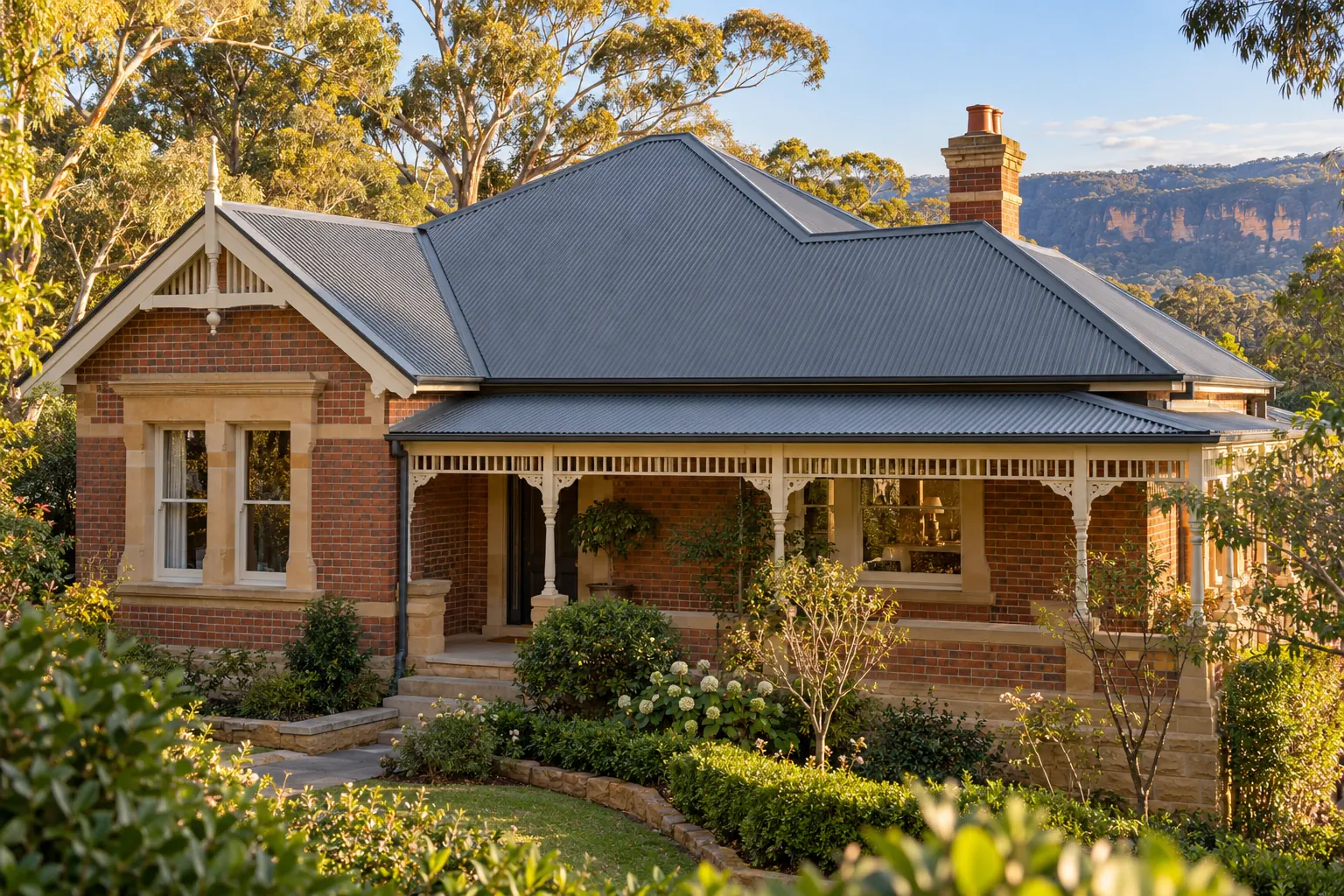
Most mountains roofs we look at are restoration candidates rather than replacement candidates. The tiles themselves are often sound; it is the bedding, the pointing, the valley irons and the surface coating that have gone. A proper roof restoration — clean down, rebed and repoint the ridges, replace broken tiles, recoat — buys a long stretch of extra life for a fraction of a re-roof.
Replacement earns its keep when the battens are failing, when the roof has been patched repeatedly in the same places, or when you want the fire and weight advantages of Colorbond steel on a steep mountain pitch. If a repair will genuinely do, we will tell you that instead.
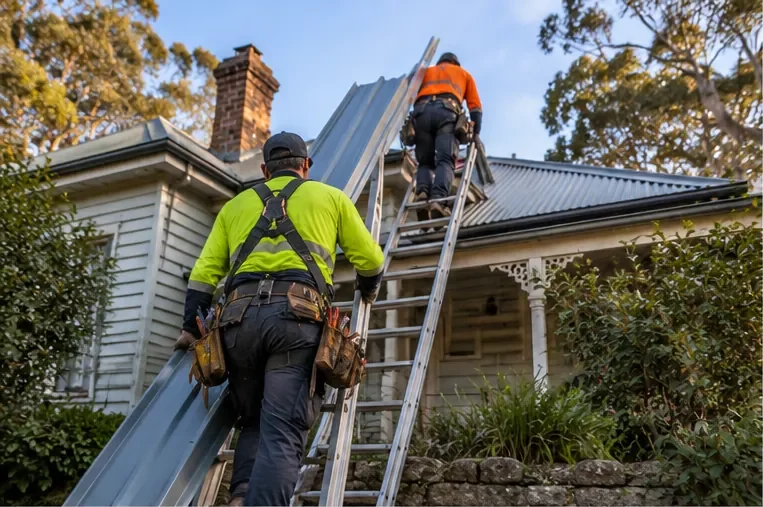
From the lower mountains at Glenbrook, Blaxland and Winmalee, through Springwood, Lawson and Hazelbrook in the middle, up to Katoomba, Leura, Blackheath and Mount Victoria at the top. The full list is on the service areas page.
Winter working windows are short above 900 metres and some blocks need a plan just to get materials to the roof. Both of those are worth factoring into when you book, and we will be honest with you about timing.
Ring (02) 4703 5000, or send the form and tell us the roof type, roughly how old it is and what you have noticed. We come out, get on the roof, photograph what we find and give you a written quote. No pressure and no chasing phone calls afterwards. Work is carried out by established, licensed and insured roofing contractors working to NSW Fair Trading requirements, and every job carries a written workmanship warranty.
A no-cost inspection and a clear written quote — no pressure and no call-back pestering.
Work is carried out by established, licensed and insured roofing contractors working to NSW Fair Trading requirements.
Gutter guard and roof-line detailing appropriate to bushfire-prone land, discussed up front.
Every job carries a written workmanship warranty.
Leak and tile repairs from Glenbrook to Mount Victoria, where moss on shaded pitches and frost-damaged pointing cause most failures.
Learn more →Full re-roofing for mountain homes: weatherboard cottages, Federation houses and steep-pitch builds, each specified for the climate it sits in.
Learn more →Colorbond roofing across the mountains, with non-combustible detailing for homes on bushfire-prone land.
Learn more →Restoration suits mountain tile roofs better than most: stripping moss and lichen, rebedding ridges and recoating so the roof sheds water again.
Learn more →Gutter replacement and ember guard for Blue Mountains properties, where leaf litter and ember entry are the same problem.
Learn more →Emergency response across the mountains after heavy rain, hail or wind, starting with a make-safe the same day.
Learn more →Roof inspections and written reports for mountain homes, including pre-purchase checks and insurance documentation.
Learn more →It changes a great deal. Above Lawson the roof goes through repeated freeze-thaw cycles every winter: water soaks into bedding mortar and ridge pointing, freezes overnight, expands and breaks the mortar apart from inside. That is why upper mountains roofs need repointing far sooner than roofs on the coastal plain, and why we use flexible pointing compound rather than a rigid sand-and-cement mix.
Usually yes, but the material, profile and colour matter. Blue Mountains LEP 2015 lists the heritage conservation areas and the detailed controls sit in Part D of the Development Control Plan, so a like-for-like replacement in a sympathetic profile and colour is the straightforward path. We will tell you at the inspection whether what you want is likely to need a development application, and we do not guess on your behalf.
Because that side is almost certainly facing south, under canopy, and it never gets enough sun to dry out. Moss and lichen hold water against the tile surface and their roots creep between the tiles, lifting edges and opening a path for water. On a north pitch on the same house the tiles can still be clean. The shaded pitch is where the roof ages first.
Make-safe comes first and it is the priority call. We get a tarp or temporary sheeting over the opening and stop the water, then book the permanent repair once the roof is dry enough to work on properly. Access up here can be slow in fog or heavy rain, so ring (02) 4703 5000 as early as you can rather than waiting to see if the ceiling holds.
Size and pitch first, then material, then access. Steep mountain pitches and tight bush blocks need more edge protection and more time on scaffold. How far the damage has already travelled matters too: a wet batten or a rotted valley board costs more than the tile that let the water in. We measure the roof, then write the number down. No figure before we have been up there.
Tell us what you need and we'll get straight back to you. Prefer to talk? Call (02) 4703 5000 and speak to someone local.
Call (02) 4703 5000